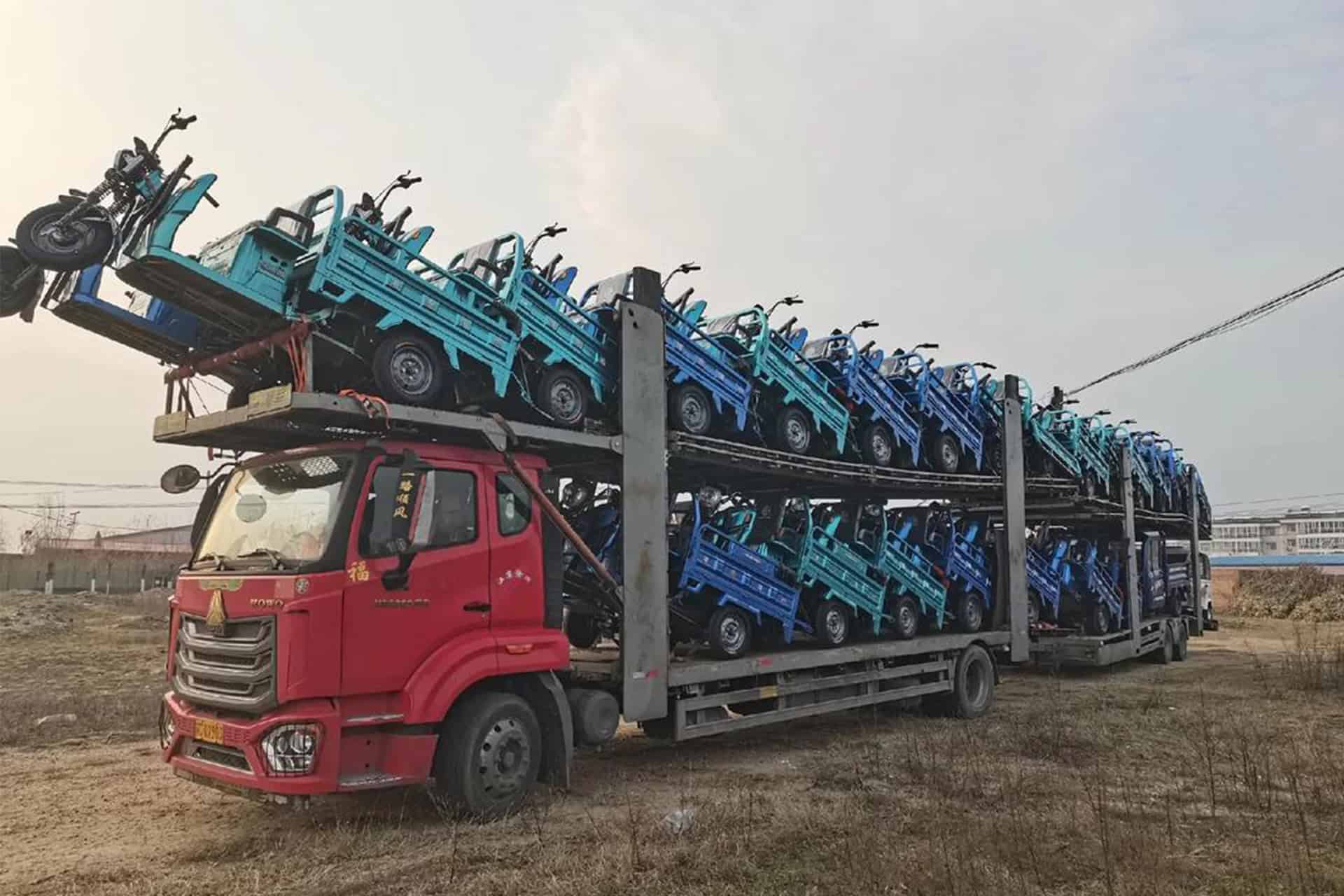
Understanding the Engineering of Heavy-Duty Tricycles In the logistics and agricultural sectors, two questions dominate: “How much can it carry?” and “How far will it go?” While many manufacturers claim high payloads, true performance depends on the synergy between three critical engineering components.
Battery Type
The battery is more than just a power source; it dictates the thermal stability and range under load.
The 80km Standard: To achieve a reliable 80km range with a full load, we recommend a 60V/58Ah or 72V/52Ah configuration as the baseline.
Lithium vs. Lead-Acid: For commercial fleets, Lithium-ion offers higher energy density and a longer lifecycle, significantly reducing the Total Cost of Ownership (TCO) over time.
Motor Power
The motor converts energy into the “pulling power” needed for slopes and heavy cargo.
1000W Baseline: For loads over 500kg, a 1000W motor is the minimum.
High-Torque Upgrades: For hilly terrain or 1-ton payloads, upgrading to 1200W, 1500W, or 2000W ensures the motor doesn’t overheat and maintains a consistent speed, preventing premature wear.
Cargo Bed & Chassis Design
A powerful motor is useless without a frame that can handle the stress.
Reinforced Steel Framing: Look for industrial-grade steel and a reinforced chassis to support payloads of 500kg–1000kg.
Safety Features: A low center of gravity, anti-slip flooring, and reinforced side barriers are essential for stability during sharp turns or sudden stops.
To ensure your investment delivers on its promises, look for this “Power Trio”:
Battery: 60V/58Ah or 72V/52Ah+
Motor: 1200W+ for heavy-duty use
Bed: Reinforced, spacious, and ergonomic
Need a custom configuration for your specific terrain? Contact Bory Machinery today for a technical consultation and a factory-direct quote!
 English
  Spanish
  Russian
  Arabic